Ornelia

My name is Ornelia, I’m 28 years old and my pronouns are she/her.  I was born in Bénin Republic, grew up in France, and would define myself as a local of Cotonou, the Paris banlieue, and Berlin. I graduated high school in Ivry-sur-Seine, best town in the South of Paris – trust me, before moving on to competitive higher education in a Catholic private school. It was the first time I experienced being the only Black person in an overwhelmingly white space. Moving on to business school, I also noticed a surprising homogeneity in the student corps that did not fit with my personal conception of diversity, equity, and inclusion. I struggled with imposter syndrome for a long time and put an extra emphasis on trying to fit in as much as possible.
Today I have accepted the unease: I am an imposter in these spaces that are mostly built and maintained by people I’m very different from, and that’s actually great because I get to offer and discover new perspectives – which is very exciting for the curious mouse that I am.

During my internship at the Berlin office of a localization company, I helped in the foundation of an employee resource group for colleagues of the LGBTQIA+ community while volunteering for QueerAmnesty.
Seeing the electronic music industry that I currently evolved in, I can tell there is a real will to improve and learn on the topics of DEI. I only regret that the most efforts are concentrated on performative or low-impact actions. I’m not saying there are any easy solutions, or that I know exactly what needs to be done, but I hope that in joining dif we can start a dialogue between all stakeholders and center the outlook of actual diverse communities to try and bring about the changes we are all eager to see unfold.


Resources

The 2020 “black square summer” was a moment where the dance music industry seemed to gain a certain awareness of ordinary racism and classism that was expressing itself within it. However it is unsure whether this realization actually helped  Black artists in any meaningful way. This article explores subtle negrophilia in club culture, and how it often prevents real progress as individuals are not able to see its deep roots in racism, which stands in stern contrast to appreciation: technomaterialism.com/negrophilia-in-club-culture.
And this other long form piece narrates the gentrification of jungle music and the intersectionality of race and gender within the genre, as a system known in other music communities too: mixmag.net/feature/nightclubs-arent-utopia-for-every-black-raver

Electronic music is Black history: get to the roots of various genres directly tied to Black culture
blog.minimal.audio/electronic-music-is-black-history, medium.com/@justsaadpp/the-black-queer-and-latino-origins-of-electronic-music-decolonizing-the-dance-floor-c63e4ad95137
Learn about the history of DnB in its societal context: bbc.co.uk/sounds/play/p0cp95yr, and about the renewal of the Paris club scene tsugi.fr/paris-ou-en-est-la-culture-club (article in French, please use an automated translator).

2023 was a difficult year for festivals in terms of expenses, ticket sales, logistics, etc. In this article, a promoter reflects on a different festival model: eamonwyss.medium.com/letting-go-by-design-social-prototyping-in-electronic-music-culture-75bebc313cef

Often DEI implementation in corporations is justified by increased monetary gains instead of being seen as a goal in itself. This article highlights the limit of such an approach and suggests a new reading grid: fastcompany.com/90462867/why-the-business-case-for-diversity-isnt-working

Anyone working in the cultural industry knows how usual late payments are. This article ponders on this general practice and offers a glance at how it helps maintain the kyriarchic status quo: technomaterialism.com/late-payments-as-a-systemic-issue-in-the-cultural-industry

Through the lens of bell hooks’ teachings, Business Teshno calls upon the music industry to demonstrate political solidarity beyond feckless support: groove.de/2020/12/23/business-teshno-a-call-for-solidarity-in-the-electronic-music-industry

A DJ and a writer deep-dive into politics and power dynamics within the electronic music scene in a lively dialogue: babmag.co.uk/abuse-of-power-in-electronic-music-a-conversation
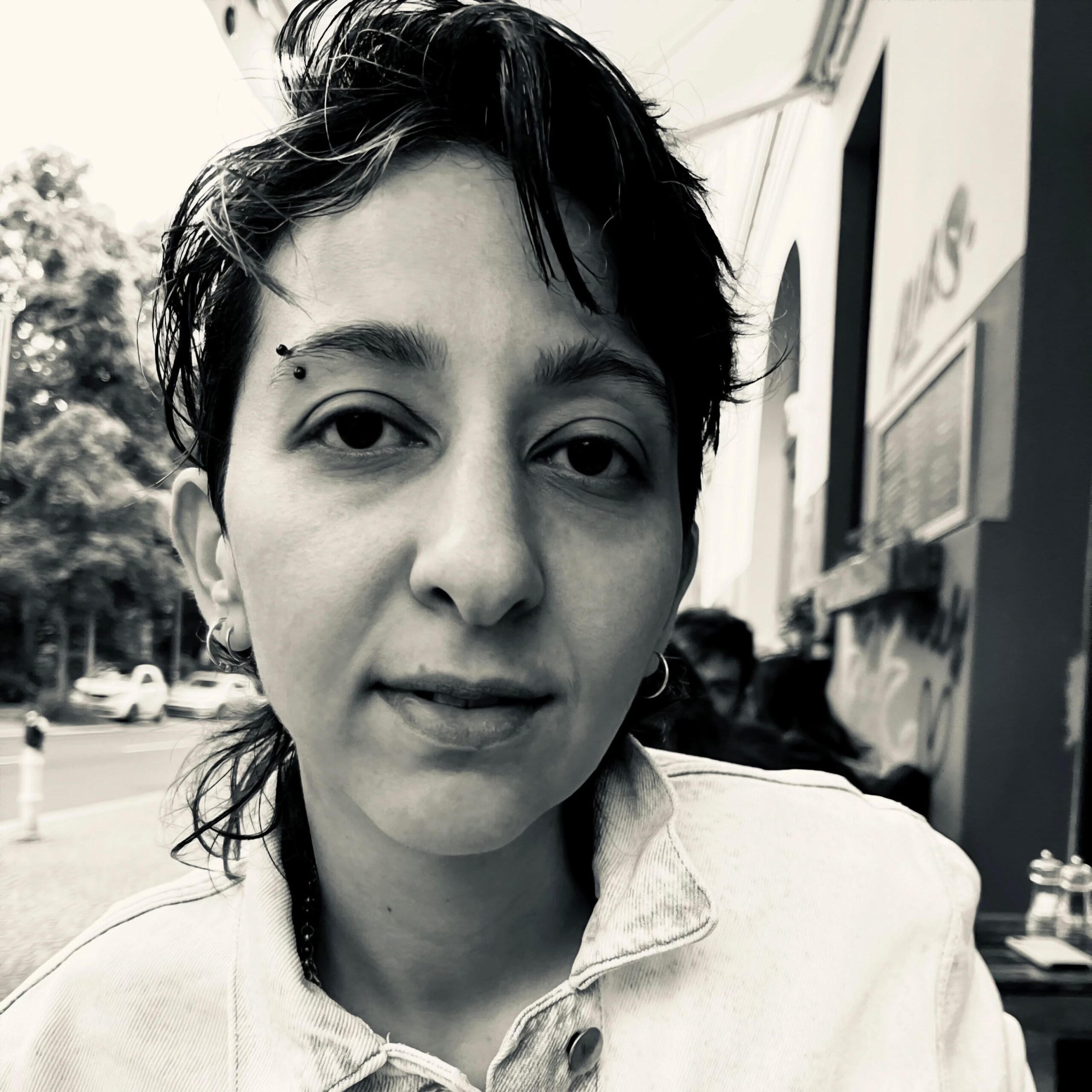
 

Nadia Says

Hello and welcome to dif, I am Nadia Says, one of the founders, and you can refer to me using the pronouns she or they. I have had many different hats in my professional life that has taken me to three different continents and, slowly but surely, has opened my eyes to many of the systems we live in and that are designed to keep us down, because imagine what we could do if we were free… In my current work as a curator, consultant, and educator mostly in the music industry and as founder of Your Mom’s Agency, I often have conversations about what freedom could mean: is it a world where artists can earn a living without the pressures of social media, is it a safer space where identity no longer matters, or is it a place where we all have the same means to fight injustice each time we face it, or a billion things more because freedom means the sky is the limit.

DEI means a lot to me in my work, in my personal life, and as a solution to most challenges of our current society; and within DEI I’d say the most important piece is currently intersectionality because communities and individuals should not be put into lonely and rigid boxes; all our demands for freedom and fairness are connected, we can only create a better society all together. How can we get along and get some important work done? This is what we will try and address at dif, at least for the music industry.


Resources

Postcolonialism alert: in 2023 the EU raised 130M by rejecting visas mostly from Black or Brown musicians from Africa and Asia. EU artists can mostly play easily in these countries, but the EU does not want to hear these artists’ music; they instead steal financial resources to weaken these artists: theguardian.com/global-development/article/2024/jun/25/african-asian-musicians-artists-condemn-humiliating-uk-eu-visa-refusals. As follow-ups, Tamizdat comment on the same subject in the USA, and Le Guess Who Festival tells stories of denied visa: https://cdm.link/le-guess-who-and-broken-visa-system.

A study by the numbers initiated by consultant and analyst Janishia Jones to show intersectional patterns within our industry: pubroyaltyqueen.com/infographic. Plus easy to read DEI numbers and food for thought pieces by multiple writers and researchers: pec.ac.uk/diversity-and-inclusion

Yes, this one is very long, but WoI’s methodology is on point, this letter has achieved a lot and is worth your time: http://itsrosh.nfshost.com/letter‘ and in this piece, he talks about the commodification of identities and the taboo subject of self-tokenization  worksofintent.com/onehouse.

Another long one by Patrick Hinton that shows why the intersection of class with all other characteristics changes all perspective, and why we will only make it if we manage to pull everybody’s resources together: mixmag.net/feature/how-cost-of-living-crisis-impacting-djs-producers-musicians-dance-music-nightlife-impact-investigation.

Real talk with London DEI activist Saskhia Menendez, if you are in the mood for an easy-going podcast. Also read the Global Trans Charter she has designed to support trans and nb individuals and their allies in the music industry.

Art x culture x politics x society podcast series by Berlin-based performer and DEI advocate Mad Kate who invites a vast variety of speakers.

The theory about sober-shaming by Eline Van Audenaerde plus follow-up practical tips, and don’t forget “It’s your body, your choice, and no justification is needed. When you say YES, you don’t go into a lengthy explanation as to why; so NO is a full sentence.”

Something about ageing in the dance music scene by Nicky Montes.


Gizem Oruç

Hi! I’m Gizem (they/them), aka 6zm, I am an artist and tech professional based in Berlin. Besides music under my pseudonym, my creative portfolio extends to film, theatre, and interdisciplinary art projects.

As a transmasculine non-binary person of color, it’s crucial for me to celebrate the intersections of creativity, queerness, and identity politics with a feminist and inclusive perspective. I am interested in making culture more accessible, hence, in addition to being a co-founder of  dif, I am part of the queer feminist collective OYA Bar, a community-driven space dedicated to creating a safer and more accessible environment, particularly for sexual and gender minorities of color and their allies.

We are more than ever in need of sustainable ecosystems based on intersectional solidarity. Exploitation and marginalisation come in multiple forms, and seeing the interconnections between these is key to understanding the injustice systems of the modern world; so that we can discover new ways to break the cycles of oppressions, until there is no more exploitation of the body, labour, and land. These are the reasons why I am part of dif.

Resources

One of the best reads I have encountered about accessibility: PromiseAndPractice.art/static/Accessibility_in_the_Arts_A_Promise_and_a_Practice_Carolyn_Lazard-e40d9ec67e82e5b3462ea6063c473c76.pdf

An inspiration and reminder that we all need to appreciate shows of love as a means of individual support and means of working together: All About Love: New Visions by bell hooks

An interesting code of conduct by a Black collective of music industry pros in the UK, can be applied to different cultural industries and Western countries:  Equitrack.blim.org.uk/anti-racist-code-of-conduct

Together with three other artists, we discussed gender representation in the music industry, away from binaries and pink-washing: NBHAP.com/berlin/soli-tunes-gender-representation

Zuzana Hamm

Hi, I’m Zuzana Hamm (she/her) aka Friday. I’ve been working in the electronic music industry since 2008 and going out to parties in Berlin since 2010, which later on led to active involvement in the local scene including organising events. One example is Meetup Berlin, an event I had been co-organising with a group of friends for FLINTA electronic music producers, DJs and VJs in Berlin since 2016, and free community music events and accessible music making workshops at Common Ground (KOMA Elektronik). Currently, I work for Resident Advisor as a City Manager for Berlin and independently as an artist, DJ, and promoter.

Thanks to listening to and exchanging conversations with artists throughout my professional and personal life, I learned more about various issues many people face when it comes to taking space in the scene due to their background, gender, age, and other aspects. I live for music and community and look at issues holistically as most issues in the music industry as well as other areas in society are complex, from structural to personal, therefore I find intersectionality crucial when it comes to helping others and finding solutions. We should all feel supported, connected and alleviate each other.

Resources

Read about how Jaymie Silk questions intentions and achievements behind general DEI implementation in the music field: https://dwellerforever.blog/2023/07/suspect-desire

Olcan Akçay

Hej, I’m Olcan (he/him) a Berlin-based communication designer and photographer, and I am looking forward to tackling discrimination in today’s world, to make it a safer space for everyone, no matter what their orientation, gender, or beliefs are.

I will mostly support dif with my designer and photo/videography skills, and will help with research and translations as I am trilingual. For me it is important that thanks to DEI we break down privilege systems by giving everyone equal access to ressources and information, so we can all reach the same goals we set for ourselves.

Tackling injustice in today’s society is something that has become important to me as I have seen it happen with family members and friends; I would like to raise my voice in solidarity. Of course we also need tackle that good old patriarchy, as it is way outdated and toxic for the entire society and our well-being, we can no longer be controlled by people who do not evolve and see the beauty in positive change.

Resources

I had the pleasure of meeting Chase before this book was published, and I have always been inspired by his mindset “think big, without hesitation, it doesn’t matter what others say”. This book breaks it once more down and gives leads in a freeing creative process.
Chase Jarvis, Creative Calling: Establish a Daily Practice, Infuse Your World with Meaning, and Succeed in Work + Life

A book that can help getting back on track by empowering yourself and bringing you closer to your goals.
Kain Ramsay, Responsibility Rebellion: An Unconventional Approach to Personal Empowerment

Quick overview about the importance of DEI in talent development and recruitment in HR www.forbes.com/sites/markcperna/2023/04/25/the-latest-dei-research-and-how-to-find-an-employer-who-shares-your-values/ and on campus https://theconversation.com/5-ways-that-college-campuses-benefit-from-diversity-equity-and-inclusion-programs-208905

An atypical study about workplace design and diversity: www.psychologytoday.com/gb/blog/people-places-and-things/202312/workplace-design-research-for-todays-workplaces


Ana Rome

Hi, I’m Ana (she/they), born and raised in Ljubljana, Slovenia and have called Berlin my home since early 2015. Ever since I was a child, equality and fairness was something that was very deeply integrated into me and for that purpose, I wanted to become a lawyer from the age of nine. Hard work and studies ended up getting me a degree in law, only to realise that legal frames, in practice, do not offer or provide the equality or fairness for marginalised groups, FINTA folks, immigrants, and other people alike.
Shortly after I stirred away from courts and law offices, I ended up working for Radio Student, the oldest alternative radio station in Europe, whose mission is to strive for inclusion, diversity and defence of democracy since the late 1960’s. Needless to say, I never looked back. My love for electronic music has led me to start working in the music industry. As a community manager, it became even more important for me to be vocal about diversity, equality and inclusivity in today’s society and get those into practice.

Resources

Isabelia Herreral invites readers not to keep diverse women*’s participation to the creation of electronic music a secret: https://pitchfork.com/thepitch/the-secret-history-of-women-in-electronic-music-is-just-beginning-to-be-told/

Katie Thomas asks how can diversity clauses in artists’ contracts can support diversity in the live music and clubbing scenes: https://mixmag.net/feature/dj-diversity-clauses-inclusion-nightlife-dance-music